
A palace is not photographed like a beautiful hotel. Here, luxury lives in details the eye perceives without naming them: the depth of a velvet, the low light of a bar, the calm of a deserted corridor. The image has to convey that silence, that sense of a place where everything has been considered and nothing imposes itself.
In brief
Photographing a palace means coding luxury through material and silence rather than accumulation. A raking light reveals texture, a pared-back frame suggests refinement, and every image is anchored in the identity of the house. The studio translates an atmosphere, not an inventory of amenities.
Luxury plays out in the material
Marble, patinated brass, a starched cloth, crystal: it is texture that signals the top tier. A raking light reveals its grain, a flat light flattens it. Photographing a palace means, first of all, knowing how to light a material, understanding how a single source can bring a surface to life rather than crushing it under uniform lighting.
This attention to material is not a technical detail, it is the heart of the subject. In a palace, luxury is tactile before it is visual. Velvet invites the hand, crystal catches the light, patinated wood tells of time. A successful image makes you want to reach out: it conveys a sensation, not just information.
Lighting a texture
Every material has its own light. Brass needs a controlled reflection so it never tips into the garish, marble a soft source that reveals its veins, velvet a low light that carves out its depth. Knowing how to angle a source to serve a surface is precisely the craft called upon in food photography, transposed to the scale of a place.
This grammar of material is what links the worlds together. A dish, a velvet, the skin of a fruit are all photographed with the same question in mind: how does this light tell the story of this surface? It is this unified eye that gives coherence to a whole commission, from the table to the suite.
Silence as the subject
A palace is also recognised by what it does not show. The emptiness of a corridor at first light, a table laid for someone absent, an armchair in subdued light: these images speak of calm and space, two rare luxuries. Silence becomes a subject in its own right, and absence a suggested presence.
Photographing that silence calls for restraint. You have to resist the urge to fill everything, accept the void, let the frame breathe. It is often the barest image that best conveys the idea of an exceptional place.
Less of everything, better of each thing
Luxury is suggested more than it is displayed. A pared-back frame, a single point of focus, plenty of darkness around it: the image gains in poise what it loses in information. It is the same stance as a plate of gastronomy, where the emptiness of the plate sets off the chef's gesture. To reduce is to concentrate the eye on the essential.
This economy of means is a choice, not an easy option. It is harder to make a strong image with a single object than with a crowded scene. Minimalism demands precision: every element kept has to earn its place. It is a rigour we bring to all our art direction work.
The hour and the exterior, the palace's other face
A palace does not end at its interiors. Its facade, its courtyard, its terrace all take part in its image, and they obey a simple rule: the hour decides everything. Midday light crushes an architecture, while the blue hour, that brief moment just after sunset, dresses it. The windows light up, the sky keeps a depth, and the building seems to breathe. It is almost always at that moment that luxury hospitality exteriors are photographed.
Composing with architecture
Photographing a building calls for a discipline of line that food photography never demands. Straight verticals, respected symmetries, controlled perspectives: a crooked facade betrays the amateur. You correct the converging lines, choose an axis that sets off the entrance, and wait until no car or passer-by breaks the frame. The palace then presents itself in its full poise, dignified and composed, like an official portrait.
The spaces that make the experience
A palace also tells its story through its sequence of places: the lobby that welcomes, the hushed bar, the silent spa, the suite with a view, the rooftop at sunset. Each has its own light and mood, and a complete reportage strings them together like the chapters of a single story. Thinking through that sequence, from the most public to the most intimate, gives the house a rich and coherent image, usable across all its media.
Photographing a place that receives
A palace is not just a set, it is a place that receives. Behind every material lies an art of hospitality, made of attention and invisible service. Translating that into an image means understanding hospitality from the inside, its rituals, its codes, its way of making luxury feel natural. It is no accident that Jordan Sapally, before photography, studied tourism and worked in hospitality: that culture feeds his eye for places.
A place tells a story
A bedroom, a lobby, a spa are not neutral spaces: they tell a story, an era, an idea of comfort. The attentive photographer captures that narrative rather than drawing up an inventory. A successful palace image answers a simple question: what does this place make you feel as you step inside?
This narrative reading of a place is at the heart of our hospitality projects. We do not photograph square metres, we photograph a promise of experience, that of suspended time and a service that anticipates everything.
The human, without showing it
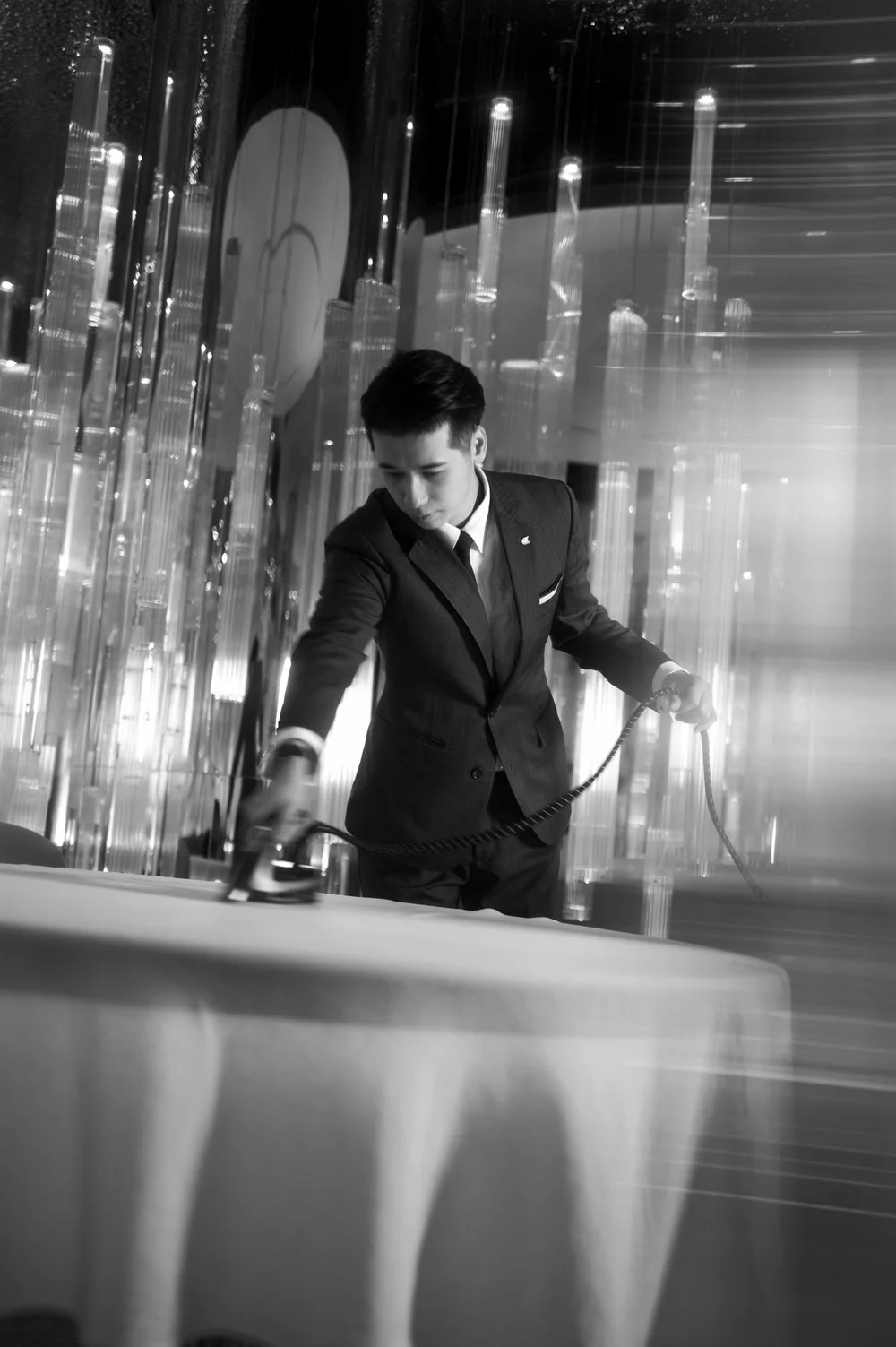
Service makes the palace, but it shows itself with restraint. Rather than staff posed for the lens, we favour their traces: a hand setting down a tray, a blurred silhouette at the end of a corridor, an object freshly arranged. These hints suggest attention without breaking the privacy the clientele comes to find.
This way of suggesting the human echoes the logic of reportage in the kitchen: capturing the gesture rather than the pose, the moment rather than the staging. Service is told in small touches, never by demonstration.
Hospitality imagery
An exceptional place to bring to life in images? Let's talk about your house.
Tying the image back to the house
Le Meurice, the Plaza Athénée, the Ritz: each house has a character. The studio's role is to anchor every image in that identity, so a single photograph stays recognisable among all others. A generic luxury image serves no one; an image that carries the signature of a specific house builds its brand with every appearance.
This work alongside the great tables is not theoretical. In his interview for Flannie, Jordan Sapally speaks of the kitchens of Le Meurice, in Paris, beside chef Amaury Bouhours. In May 2026, the programme 50mn Inside on TF1 followed him behind the scenes at the Majestic, in Cannes, during the Festival. These experiences feed one conviction: every house deserves an image that resembles it, not a mould applied to all.
Tying the image back to the house means, finally, thinking about consistency over time. A suite photograph, a restaurant dish, a bar shot and a mood film all have to speak the same visual language. It is this unity, from the creative studio to the final campaign, that turns a series of beautiful images into a true brand identity.
Frequently asked questions
- What sets photographing a palace apart from a classic hotel?
- A palace is photographed through material and silence rather than accumulation. Marble, patinated brass, crystal, velvet: it is texture and light that signal the top tier. Where a classic hotel shows its amenities, a palace suggests an atmosphere, a calm and a refinement that are felt without being named.
- How do you convey luxury in a hotel image?
- By taking away rather than adding. A pared-back frame, a single point of focus, plenty of darkness around it, a raking light that reveals the grain of materials. Luxury is suggested more than it is displayed: the image gains in poise what it loses in information, exactly like a plate of fine gastronomy.
- Should you show the staff and guests of a palace?
- Rarely head-on, often by suggestion. A blurred silhouette, a hand setting down an object, a table laid for someone absent: the service is told through its traces rather than through extras. This restraint preserves the privacy a palace clientele seeks while conveying the care given to every detail.
- Why must an image match the identity of the house?
- Because a palace sells a signature as much as a service. Each house has a character, and an image that fails to respect it weakens the brand. The studio's role is to anchor every photograph in that identity, so a single visual stays recognisable and consistent across every medium.
About the author
Jordan Sapally
Photographe culinaire et directeur artistique
Jordan Sapally dirige un studio créatif dédié à l'image culinaire et hôtelière de luxe. Formé par l'hospitalité et le voyage, il travaille pour des restaurants étoilés, des palaces et des marques food premium, en France et à l'international. Son parti pris : une image sensible, cohérente et durable, au service de la cuisine et du produit.