
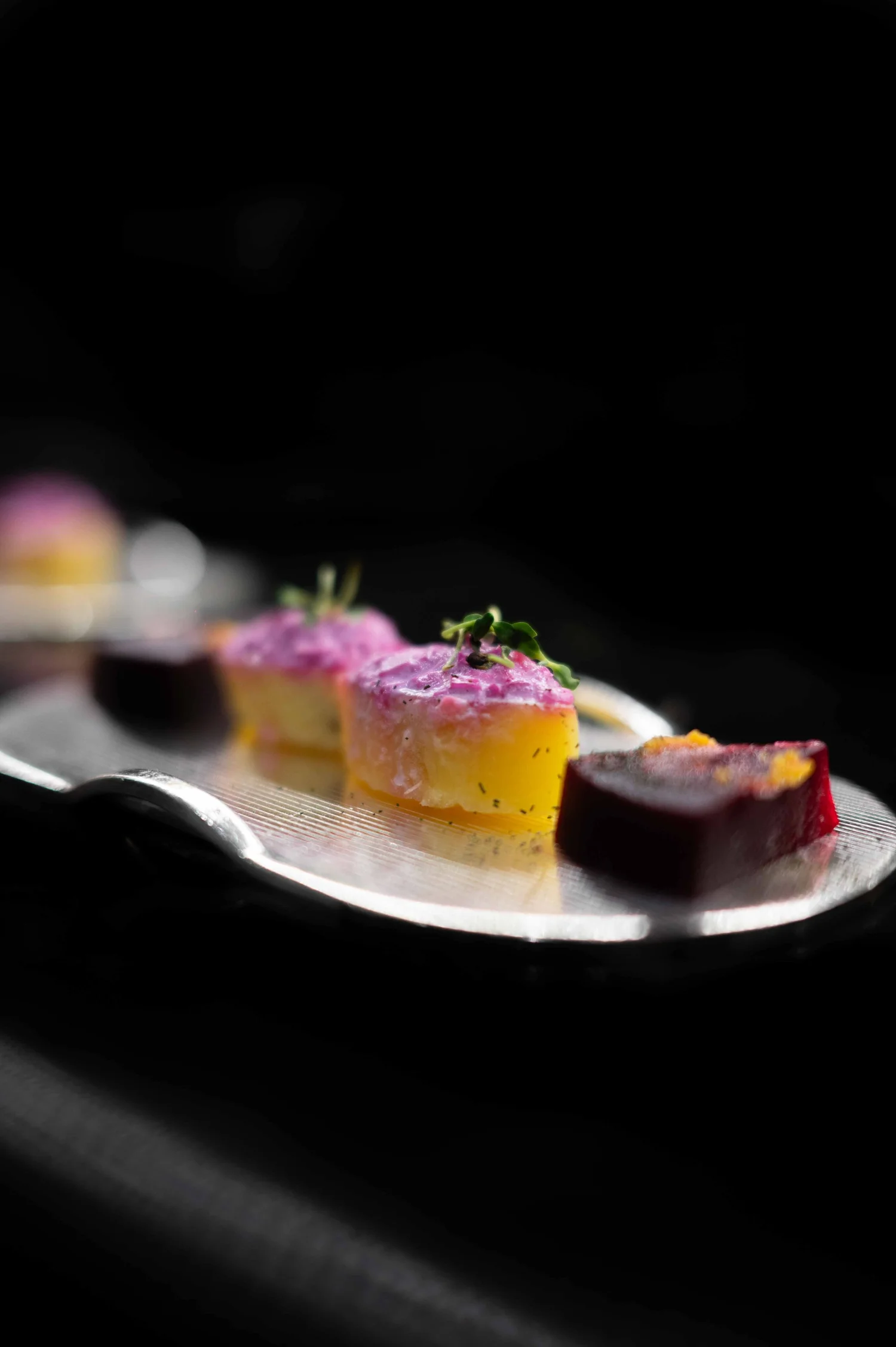
Light is not a setting, it is a point of view. Before talking aperture or colour temperature, you have to decide what you want to make felt: the freshness of a raw product, the density of a sauce, the tension of a plate of gastronomy. Each light source responds differently, and this choice commits the image far more than the camera body.
In brief
In food photography, natural light tells the truth of a product and serves reportage, while artificial light sculpts a reproducible intention for campaigns. The craft is not to choose a side, but to know which source serves the dish, the house and the message.
Natural light tells the truth
A north-facing window gives a soft, directional light, without hardness. It respects the material: the mist on a glass, the fat beading up, the crumb still warm. It is the stance of sensory images, those where you want the viewer to almost taste it. North light never receives direct sun, so it stays stable and enveloping all day, which makes it the reference for most food studios.
This choice is not only aesthetic. Natural light, well read, tells where a product comes from and at what hour it was captured. It sets the dish in a real moment, where reconstructed lighting can ring generic. It is also what brings food photography close to the still life: the same attention to the way a single source reveals a volume.
Jordan Sapally's stance
This stance is anything but theoretical. In an interview given to Flannie, Jordan Sapally sums it up plainly:
"Light. It is something that can sometimes be a problem because I always work in natural light. It is very rare for me to bring in a spot, an artificial light."
This exacting standard goes hand in hand with a claimed economy of means. Still in the same interview, he describes a minimalist approach: entering a restaurant with only his camera body and a 35 mm, no other lens. A focal length open to f1.8 that, in his words, comes close to the look of film and gives a very beautiful blur to the image. The technique keeps a low profile to make room for the eye, a principle found at the heart of the move from photographer to creative studio.
The limits of natural light
Natural light has one major flaw: it changes constantly. A cloud, an hour turning, a kitchen with no window, and the shot conceived a minute earlier no longer exists. A restaurant reportage requires composing with it rather than controlling it, which calls for anticipation and a quick reading of the space.
This is where experience comes into play. Spotting the zones where the light falls just right, knowing where to stand so a dish receives the right modelling, accepting to shoot fast when the window closes: natural light rewards those who observe it, it punishes those who endure it.
Artificial light sculpts the intention
Studio flash, for its part, is controlled to the millimetre. You draw a shadow, isolate a reflection, freeze a pour of sauce at a tenth of a second. It is the light of palace campaigns and premium brands, when the image has to be reproducible and hold on an advertising format, from packaging to large-format display.
Its advantage is total control. Nothing depends any longer on the weather or the hour: the same light can be reproduced the next day, on another product, with perfect coherence from one image to the next. For a premium food brand rolling out dozens of visuals across several media, this consistency is worth its weight in gold.
When flash becomes necessary
Some commissions cannot be handled other than in controlled light. A packaging image has to isolate the product against a perfectly even background. A seasonal campaign has to keep the same look from the first shot to the last. A pour, a wisp of smoke, a drop frozen in mid-air demand a source powerful and brief enough to stop the movement cleanly.
In these cases, the artificial does not impoverish the image, it sharpens it. It allows light to be thought of as a compositional tool in its own right, serving a precise art direction rather than a happy accident.
The risk of over-lighting
The danger of studio light is not technical, it is ethical. Too sculpted, a dish ends up lying: it becomes shinier, denser, more perfect than on the client's plate. In luxury, this gap is a trap. The image must remain the honest promise of what will be served, a subject we dig into in our article on food styling.
Good artificial lighting is recognised by the fact that it cannot be seen. It gives relief without shouting, it reveals the material without distorting it. Technical virtuosity is only of interest if it stays in the service of the product.
How to choose according to the house and the message
The choice of light follows from the message, never the other way round. Before plugging anything in, the real question is: what does this image have to say, and where will it live? A reportage photograph for a press kit and a campaign visual for a brand do not have the same specification.
Reportage or campaign
In reportage, natural light almost always prevails. You are after the truth of a service, the atmosphere of a kitchen, the gesture of a chef in his real environment. Reconstructing a light here would betray the subject. It is the register of houses that want to show their soul rather than a catalogue, as our food projects show.
In a campaign, the balance tips towards control. What matters becomes coherence, reproducibility, the image holding across varied media. Artificial light, or a very tightly framed natural light, makes it possible to sustain that requirement over time.
The message before the technique
A gastronomic house that wants to convey the emotion of a raw product does not have the same needs as a luxury hotel building a brand image over several seasons. The former will often gain from natural light, the latter will combine the two according to use. There is no universal right answer, only an answer that is right for this project.
This is why light is decided at the brief, not on set. Aligning the intention upstream avoids shooting something pretty but off-brief, a reflex we detail in our brief checklist.
Light and material: the real craft
At bottom, photographing a dish means photographing a material under a light. The shine of a sauce, the matt of a purée, the translucence of a slice of raw fish: each texture reacts differently according to the angle and the softness of the source. A raking light reveals the grain of a crust, a frontal light flattens it. Knowing how to angle the source is already composing the image.
This reading of material holds as much in the kitchen as in hospitality or in product still life. A marble, a velvet, the skin of a fruit are all photographed with the same question in mind: how does this light tell the story of this surface? The photographer who masters this grammar can move from one source to another without ever losing his style.
The real craft is therefore not to choose a side between natural and artificial, but to know when each light serves the dish. Technique stays in the service of emotion, never the other way round. It is this hierarchy, intention first, tool second, that separates a beautiful image from an image that rings true.
Frequently asked questions
- Do you need natural or artificial light for food photography?
- Both are justified depending on the message. Natural light conveys the truth of a product and suits reportage and sensory images. Artificial light can be controlled to the millimetre and serves reproducible campaigns. The real craft is not to choose a side, but to know when each source serves the dish.
- Why a north-facing window to photograph a dish?
- Because a north-facing window receives no direct sun: the light there is soft, directional and stable over time. It wraps the material without burning out the whites or hardening the shadows. It is the reference source for revealing the mist on a glass, the fat beading up or the crumb still warm.
- Which lens for food photography?
- There is no compulsory lens, but a fast prime such as a 35 mm f1.8 gives a look close to film, with a soft background blur. Jordan Sapally often works with this single lens, in a minimalist approach where light and the eye take precedence over equipment.
- Does the light change during a kitchen reportage?
- Yes, constantly. In reportage, you do not control the light of a service, you compose with it. It is a constraint that becomes a strength: the real light of a kitchen tells of the hour, the rhythm and the atmosphere of a house better than any reconstructed lighting.
About the author
Jordan Sapally
Photographe culinaire et directeur artistique
Jordan Sapally dirige un studio créatif dédié à l'image culinaire et hôtelière de luxe. Formé par l'hospitalité et le voyage, il travaille pour des restaurants étoilés, des palaces et des marques food premium, en France et à l'international. Son parti pris : une image sensible, cohérente et durable, au service de la cuisine et du produit.