
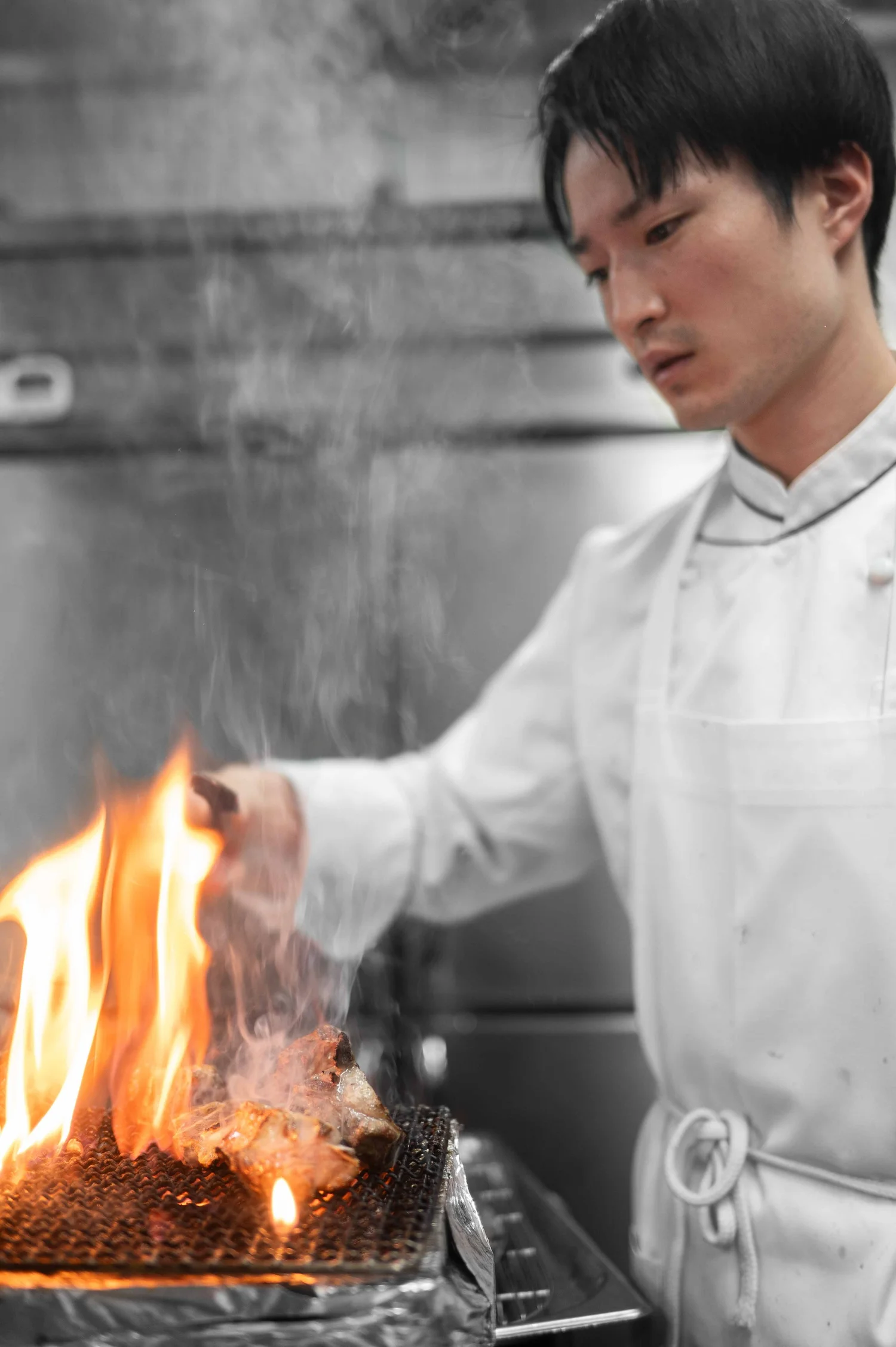
A successful reportage is not noticed during service. The photographer becomes a discreet member of the brigade: they anticipate, they position themselves, they disappear. The aim is not the beautiful plate set against a neutral background, but the right gesture at the right moment, the one that tells the story of a house without having to explain it.
In brief
A reportage in a Michelin-starred restaurant succeeds through self-effacement: scouting before shooting, photographing the gesture rather than the pose, and always putting the service before the image. These are the rules that produce true photographs and that make a brigade open its door to the photographer again.
Scouting before shooting
Half an hour of observation is worth more than an hour of bursts. You scout the zones of light, the lines of movement, the chef's rhythm. You then know where to stand when the rush arrives, without ever cutting across a path or getting in the way of a dish going out. This apparent lull is in reality the most useful moment of the day.
Scouting is not just a logistical matter, it is a reading. Every kitchen has its choreography: the pass where everything converges, the station that concentrates the tension, the instant when a plating plays out in a few seconds. Understanding this mechanism before raising the camera is already knowing which images exist and which will never come.
Reading the chef's rhythm
A chef in full service does not pose, they work. The photographer has to match their tempo, not impose it. You learn to sense when a hand is about to plate, when a flame is about to rise, when a gaze is about to settle on a plate. Anticipating these micro-moments is the difference between an expected photo and an image that captures the truth of a gesture.
This discipline of anticipation echoes a minimalist approach to equipment. The less you handle, the more you observe. It is the same principle that governs the choice of light in the kitchen: the technique steps back so the subject can breathe.
The light of a kitchen cannot be invented
A professional kitchen rarely has the dreamed-of light. Neon strips on the ceiling, pockets of shadow, reflections off stainless steel: the photographer works with what they find rather than reinstalling everything. Setting up spotlights in full service would be both impossible and dishonest, because it would betray the real atmosphere of the place.
This constraint becomes a signature. The raw light of a cooking range, the steam that catches a shaft of daylight, the glint of a blade under a pendant light: these elements tell the hour and the mood better than a reconstructed lighting setup. The reportage embraces the light of the real, with all that is imperfect and alive in it.
Photographing the gesture, not the pose
The strength of a reportage lies in movement: a hand plating, a flame rising, the concentration on a face. These images tell the story of a house better than a polished product shot. They speak of the work, the exacting standards, the moment, everything a plate set on an empty table will never show.
The product shot has its place, but it documents a dish. The reportage, for its part, documents a working culture. That is why it complements careful food photography so well: one gives the object, the other gives the context and the emotion.
From raw produce to the plate
The true story of a house begins well before the plating. Jordan Sapally explains this in his interview for Flannie:
"Photographing the transformation of the ingredient, from delivery to the dish, is what I find most interesting."
This approach has led him as much to the market as to the stove. Still in that interview, he speaks of the Cours Saleya in Nice alongside chef Emmanuel Pilon, of the Louis XV in Monaco, and of the kitchens of Le Meurice in Paris with chef Amaury Bouhours. Following a product from its origin to the plate means telling the story of a house in its entirety, not just its shop window.
The rush as raw material
The service at the pass is the moment when everything condenses. The gestures quicken, the tension rises, the concentration becomes palpable. This is where the strongest images are born, provided you are already in place. You do not replay a rush, you seize it or you miss it.
It is also the most demanding moment for the photographer, who has to be entirely present and entirely invisible. One step too many, a flash, a hesitation, and they become an obstacle. Done well, the service reportage produces images that neither the pose nor the reconstruction can match.
Respecting the service, always
The golden rule is simple: the service comes before the image. A dish must never go cold for a photo, a passage must never be blocked, a dish going out must never wait. This discipline is not an imposed constraint, it is the very condition of a good reportage. A team that feels respected works normally, and it is that normality we want to photograph.
Becoming invisible within the brigade
The finest compliment for a reportage photographer is to be forgotten. Neutral clothing, calm movements, no cumbersome equipment: everything has to work towards their disappearance. The more discreet they are, the more the gestures become natural again and the more the images gain in truth. A brigade that poses is no longer a brigade, it is a staging.
This stance of self-effacement echoes the philosophy of the creative studio: to serve the subject, never to impose on it. The eye stays strong, but the presence becomes light.
Trust, the condition for a return
A successful reportage is measured not only by the images, but by whether you are called back. A starred house protects its service and its image; it opens its kitchens only to those it trusts. Respecting the rhythm, meeting delivery deadlines, never publishing without agreement: these principles build a lasting relationship, far more precious than one beautiful one-off series.
What a reportage says about a house
A well-executed reportage does not fill a folder, it builds a reputation. Service images feed the press, the guides, social media and applications. They show the exacting standards of a table to people who often decide before even tasting. It is a communication asset as much as an artistic object.
This fieldwork has, moreover, a history with Jordan Sapally. As early as 2020, he carried out a photographic assignment for the Michelin Guide, as he recounts to L'essentiel. His kitchen reportages have since been picked up by the specialist press, right through to behind-the-scenes footage filmed for television. This recognition is no accident: it comes from a method, made of observation, respect and an eye that seeks the true rather than the pretty.
The reportage is, finally, the best ally of film and studio photography. Photographed on the same day, in the same light, with the same intention, it gives a house a coherent image, from the most polished product shot to the rawest gesture. It is this consistency that makes a signature, and it is this that people come looking for.
Frequently asked questions
- How do you photograph a Michelin-starred restaurant without disrupting the service?
- By becoming a discreet member of the brigade: you scout the lines of movement, anticipate the chef's rhythm, and position yourself without ever cutting across a path. The golden rule is that the service comes before the image. A dish never goes cold for a photo, a passage is never blocked.
- Should you photograph the dishes or the chef's gesture?
- Both, but the soul of a house lies above all in the gesture. A hand plating, a flame rising, the concentration on a face tell of the work and the exacting standards better than a staged product shot. The reportage captures the transformation of an ingredient, from delivery to the plate, not just the final result.
- How much time should you allow for a kitchen reportage?
- Beyond the shooting time, you have to allow for a scouting phase. Half an hour of observation before service is worth more than an hour of bursts: it lets you understand the light, the zones of movement and the tempo of the brigade. The rest plays out during the rush, without ever forcing the pace.
- Why a reportage rather than a simple dish shoot?
- Because a catalogue of dishes shows a menu, a reportage shows a house. Service images tell of the work, the atmosphere and the exacting standards, so many signals that a press kit, a guide or a guest look for before choosing. The reportage humanises a table and makes it recognisable.
About the author
Jordan Sapally
Photographe culinaire et directeur artistique
Jordan Sapally dirige un studio créatif dédié à l'image culinaire et hôtelière de luxe. Formé par l'hospitalité et le voyage, il travaille pour des restaurants étoilés, des palaces et des marques food premium, en France et à l'international. Son parti pris : une image sensible, cohérente et durable, au service de la cuisine et du produit.