
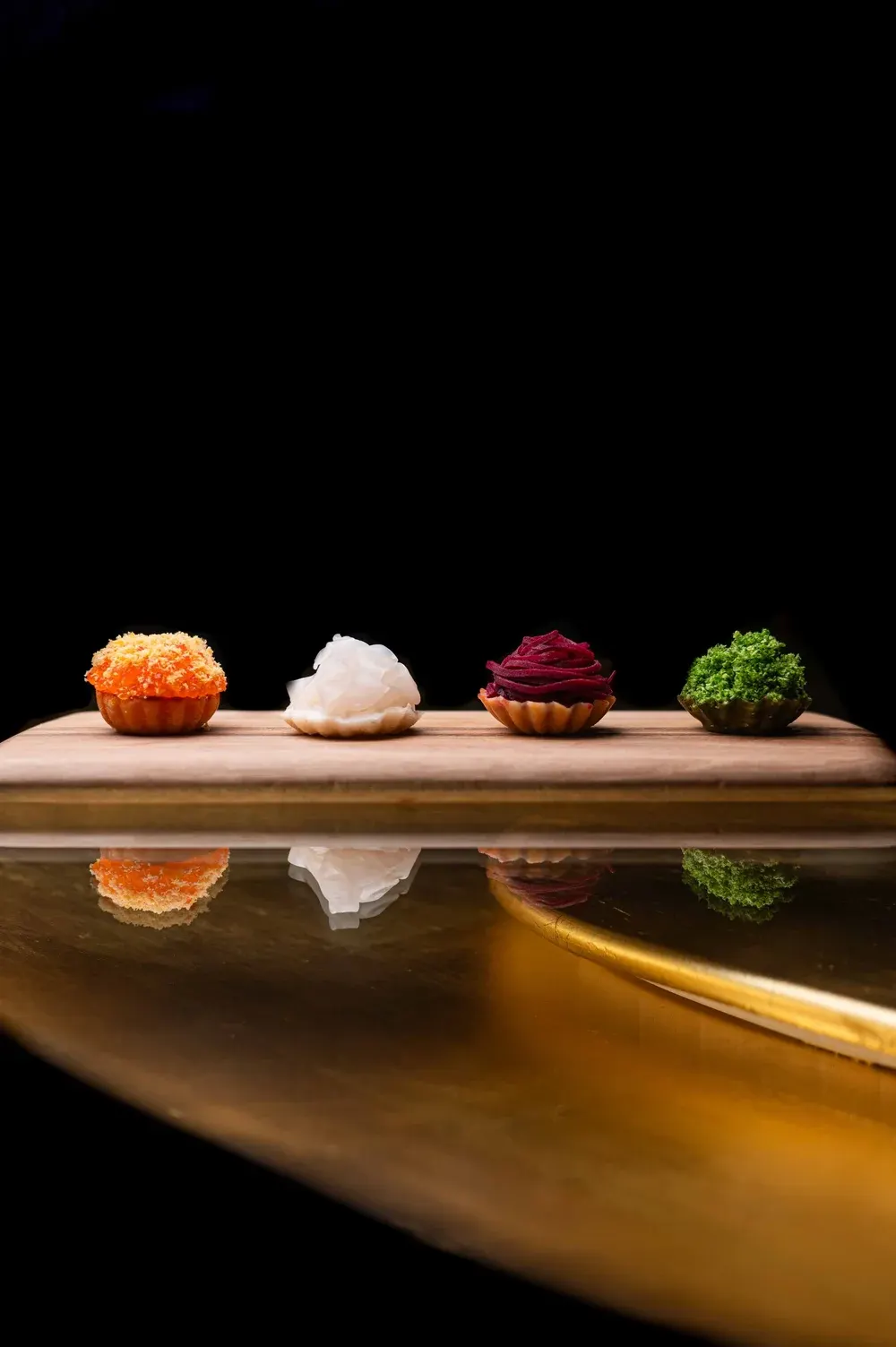
A photograph captures a moment, film sets up a story. The pouring of a sauce, the rising steam, the crunch you can hear: food film adds a sensory dimension that the still image can only evoke. It does not replace photography, it extends its gaze into time and into sound.
In brief
Food film adds time, movement and sound to the food image. Every shot carries an intention, sound does half the work, and the story takes precedence over the effect. Conceived alongside the photography, in the same light and the same art direction, it gives a house a coherent, strong signature.
Movement in the service of the product
A camera movement is not an effect, it is an intention. You move slowly towards a dish to create desire, you follow a gesture to show the craft. Every shot has to have a reason to exist, otherwise it dilutes the story. The temptation of gratuitous movement, of the tracking shot that impresses without saying anything, is the first trap of food film.
Restraint here is a quality. A fixed shot held on rising steam can be stronger than a sequence of spectacular movements. The camera moves when the story demands it, it settles when the subject is enough. This economy echoes the minimalist approach that already guides our work with light.
Every shot has a reason
Before shooting, every shot has to answer a question: what does it tell? A close-up on a hand speaks of the gesture, a wide shot speaks of the place, a slow-motion speaks of the material. A successful food film is not an accumulation of pretty shots, it is a sequence of necessary shots, each bringing information or an emotion the previous one did not give.
This discipline is prepared upstream, in the shot breakdown. Thinking through the film before shooting it avoids a rambling shoot and a laborious edit. It is the same principle of framing the intention as a good photo brief: deciding what you want to say before turning on the camera.
Rhythm, that dramaturgy
The rhythm of a food film is a dramaturgy. The alternation of slow and fast shots, the length of a slow-motion, the timing of a cut create tension and release. Too fast, the film exhausts; too slow, it bores. The right tempo marries the subject: brisk for the rush of service, contemplative for a meticulous plating.
This sense of rhythm sets a crafted film apart from a simple montage of images. It is built during the shoot, in the choice of durations, and chiselled in the edit. That is where the film finds its breath and becomes a story rather than a demonstration.
Sound does half the work
The sizzle of a pan, the clean cut of a blade, the silence before the tasting: sound carries the appetite as much as the image does. A beautiful silent film remains a beautiful cold film. Sound is not a finishing layer added at the end, it is a material in its own right, conceived from the shoot and worked in the edit with as much care as the image.
Sound design transforms the perception of a dish. The crunch of a crust, the liquid of a sauce, the edge of a knife awaken an immediate sensory memory. It is this synaesthesia, hearing in order to want to taste, that makes the strength of the video format, on social media as much as in brand communication.
Sound as appetite
Some sounds trigger appetite more surely than an image. The famous sizzle, the crackle, the pour: these are universal signals of indulgence. Capturing them cleanly, up close, without parasitic noise, calls for real sound recording work on the shoot. A dirty sound ruins a perfect shot, a true sound elevates a simple one.
Music and silence
Music steers the emotion, but silence has its force too. A moment without music, just the direct sound of a kitchen, anchors the film in the real and creates a breath. Alternating a musical bed with direct sound avoids the smooth advertising effect and gives the film a more sincere texture, closer to the spirit of a house of gastronomy.
From the dish to the story
Film excels where photography reaches its limit: the passing of time. It shows a transformation, from the raw product to the finished plate, a progression the still image can only suggest. This story of gesture and material is exactly what led Jordan Sapally, after five years of photography, to found his studio and extend his eye to film and to more ambitious productions.
This move to the moving image naturally extends reportage in the kitchen: the same gestures, the same demand for truth, but with movement and sound as well. Film tells the story of a house over time, it shows a body of work rather than a result, a team rather than a catalogue. It is a powerful brand storytelling tool, from the gastronomy film to the filming of an event. The studio makes it a pillar of photo and video content creation for brands and places.
A format for every use
A food film does not take the same shape depending on where it will live. The brand film, in landscape format, sets up a story over one to two minutes: it opens a website, accompanies a campaign, is screened at an event. The vertical format, for its part, reigns on social media: shorter, more direct, it captures attention from the very first second and favours the immediate gesture, the pour, the crunch.
Thinking of these uses from the shoot avoids clumsily recropping a landscape shot into a vertical one. You then shoot with both formats in mind, composing the shots so they work in both frames. A single shoot can thus produce a long film, several short teasers and a series of shots for social media, each adapted to its own ratio.
This economy of means echoes the studio's logic: pooling a single day of shooting to feed several channels, without ever sacrificing consistency. From the signature film to the few-second story, everything has to speak the same visual language and carry the same house signature.
Photography and film, one signature
The studio conceives the two together. The same light, the same art direction, the same demand for truth. The consistency between the photography and the film is what gives a house a strong, recognisable image. Filming and photographing on the same day, in the same spirit, avoids the gap in rendering between two separate engagements and guarantees a unity the audience perceives without naming it.
This ability to move from the still image to the moving image is not just a promise. In May 2026, the programme 50mn Inside on TF1 followed Jordan Sapally behind the scenes at the Majestic, in Cannes, during the Festival. Moving with ease in front of and behind the camera, in such a demanding setting, says one thing: storytelling in motion is fully part of the studio's craft, on the same footing as production.
At heart, food film is not a separate service, it is an extension of the gaze. It applies to duration what photography applies to the instant, with the same hierarchy: intention first, technique second, the product always at the centre. It is this continuity, from the creative studio to the delivered film, that turns a house into a brand with a coherent image.
Frequently asked questions
- What does food film bring compared to photography?
- Film adds time, movement and sound. Where a photograph captures a moment, film sets up a story: the pouring of a sauce, the rising steam, the crunch you can hear. It adds a sensory and narrative dimension that the still image can only evoke, ideal for conveying a craft or an emotion over time.
- Is a camera movement always useful in food film?
- No. A camera movement is not an effect, it is an intention. You move slowly towards a dish to create desire, you follow a gesture to show the craft. Every shot has to have a reason to exist, otherwise it dilutes the story. A camera that moves without reason tires the eye and weakens the message.
- Is sound important in a food film?
- It does half the work. The sizzle of a pan, the clean cut of a blade, the silence before the tasting carry the appetite as much as the image does. A beautiful silent film remains a beautiful cold film. Sound design turns a series of shots into a complete sensory experience.
- Should you shoot the film and the photography on the same day?
- It is often the best choice. Photography and film conceived together share the same light, the same art direction and the same demand for truth. Pooling the day guarantees perfect consistency between the film and the still images, and gives a house a strong, recognisable visual identity.
About the author
Jordan Sapally
Photographe culinaire et directeur artistique
Jordan Sapally dirige un studio créatif dédié à l'image culinaire et hôtelière de luxe. Formé par l'hospitalité et le voyage, il travaille pour des restaurants étoilés, des palaces et des marques food premium, en France et à l'international. Son parti pris : une image sensible, cohérente et durable, au service de la cuisine et du produit.