A champagne photographer does not only photograph a bottle. The work is to picture an entire house: its hillsides, its cellars, its know-how and the moments when it is opened. The difficulty fits in one sentence. Champagne speaks of celebration, yet it is born of long years, and the image has to hold both without falling into cliché. This guide is for champagne houses, wine estates and premium wine brands preparing a campaign, a cellar series or an event. It draws on the studio's work for Dom Pérignon, for Champagne La Caravelle and for Château Simone.
In brief
Photographing a champagne house means holding two timescales in one image: the celebration and the years in the cellar. The method: the bottle treated as a portrait, the cellar and vineyard as proof of time, the table as the moment, and French advertising law known from the brief.
What should a champagne house's imagery convey?
A champagne house's imagery has to convey two moments at once: the instant the bottle is opened and the years that came before it. The celebration is visible straight away. The long years have to be shown, because they are what gives a great house its value, and no label makes them visible.
The stakes are played out in images. According to the key figures of the Comité Champagne, 266.1 million bottles were shipped in 2025, 57.1% of them for export, by 410 houses and 16,460 growers, from 34,200 hectares across 319 villages. On a shelf, a wine list or a screen, all of these bottles share the same silhouette, the same foil and the same promise of celebration. The image is one of the few places where a house can show what sets it apart.
Time, the subject no one sees
To be called champagne, a wine must spend at least 15 months in the cellar, and three years for a vintage. In practice, the Comité Champagne puts it at 2 to 3 years for non-vintage wines and 4 to 10 years for vintages, and its cellars hold more than a billion bottles, the equivalent of almost four years of shipments. None of this can be read on a bottle. It shows through what surrounds it: the chalk of the galleries, the dust on a neck, rows of bottles fading into darkness, the hand of the person who turns them.
Celebration without the clichés
A popping cork, clinking flutes, a tower of coupes, golden confetti: these images say "party", but they say it the same way for every house. A great house has no need to shout celebration; it suggests it, with a flute poured in half-light, a bottle beaded with condensation, the light at the end of a dinner.
This restraint is Jordan Sapally's approach. Speaking about his restaurant work in an interview with Flannie, he explains that he does not like using accessories to make a shoot easier, and describes his approach as minimalist. On a champagne table, the same restraint applies to the set: every object removed gives the space back to the bottle and the wine.
The bottle, the house's first portrait
The bottle is the official portrait of a house: it is the image used on the website, on wine merchants' product pages, in the press and on social media. It is photographed like a face, with light that draws its silhouette and respects its label, then carried across the whole range.
Drawing dark glass
A champagne bottle is among the hardest objects to light. Its glass, often dark green, absorbs light; its curved surface mirrors every source; its label, matt or gilded, reacts differently from the glass around it. So it is never lit from the front. It is drawn with long strips of light along its edges, which lift its silhouette from the background, and the reflections are steered so that they never cross the label. The logic is close to that of a perfume bottle, which we detail in our method for the glass and reflections of a fragrance, with one difference: here, the tinted glass hides the wine, which only reveals itself when backlit.
One range, four sets, the same rigour
For Champagne La Caravelle, the studio photographed the whole range in 98 images. The series starts with the most restrained: bottles lined up on a white background, then the gold, silver and pink foils in close-up. It continues on a white quilted material, where light passes through the glass and casts green and orange reflections, then in chiaroscuro on black, where a single bottle of rosé glows among the flutes. It ends on a white table in hard light, with long graphic shadows. Four sets, the same rigour: each cuvée keeps its place and its colour from one image to the next.
These images do not serve the same uses. The white background feeds product pages and catalogues; the staged images feed the campaign and social media. The choice between the two is made use by use, as we explain in our comparison of packshots and staged product images.
The bubble, signature and challenge
The bubble is champagne's signature, and the hardest thing to show. It only appears when backlit, in a perfectly clean flute, in the seconds after pouring, before the mousse settles. The studio therefore photographs it at the moment of pouring, with the camera already set, the flute placed in front of the light against a dark background that brings out the gold of the wine. In the La Caravelle series, flutes lit from behind on black show what this means: the wine becomes the only source of light in the image.
Your range in pictures
Let's define the light of your range together, from bottle to flute.
How do you photograph a cellar and a vineyard?
The cellar and the vineyard are photographed as proof: they show the time and the place the bottle promises. The cellar requires keeping the darkness, the vineyard requires choosing the season, and both require bringing the people who make the house into the frame.
This trio has official recognition. On 4 July 2015, the World Heritage Committee added the Champagne Hillsides, Houses and Cellars to the UNESCO World Heritage List, in the category of organically evolved and continuing cultural landscapes. The places a champagne house photographs are exactly the ones UNESCO recognised.
The cellar: keeping the darkness
A cellar is not made to be lit, and that is what makes it beautiful. Over-lighting a gallery turns it into a corridor. The studio starts from the existing light (the lamps along the vaults, a door open at the end of a gallery) and accepts that the image stays dark. During the Dom Pérignon x CIA mentorship, in Reims, the cellar appears in just this way: vaults turned gold by the lamps, rows of bottles fading into darkness, faces lit from the side. At Château Simone, in Provence, a single image is enough to convey time: bottles lying in the cellar, the glass covered in dust.
The vineyard: choosing the season
The vineyard changes its face through the year: bare canes in winter, tender green leaves in spring, ripe bunches at the end of summer, golden foliage in autumn. Each season tells a different story, and a house chooses its own according to its narrative. The harvest is the shortest and the liveliest; in Champagne, it brings in more than 100,000 seasonal workers, according to the Comité Champagne. At Château Simone, the studio followed the harvest from start to finish: pickers in the rows, crates of white grapes, the press, steam rising in the winery, then lunch on a checked tablecloth. In Champagne, for Dom Pérignon, the series opens on hillsides in full leaf under a cloudless sky.
The people of the house
Cellar master, grower, picker, sommelier: a house is first and foremost its people. Their gestures convey know-how better than any text: a hand on a bunch of grapes, a glass raised to the light, a note taken during a tasting. It is also the register favoured by the French rules on alcohol advertising, as we explain below. Every recognisable person gives written consent before publication.
The table and the event: photographing the moment
At the table, champagne is photographed with what it accompanies: the dish, the glass and the bottle form a single composition. An event is told in two complementary series: the images of the table, composed and precise, and the reportage of everything happening around it.
A pairing is composed like a still life
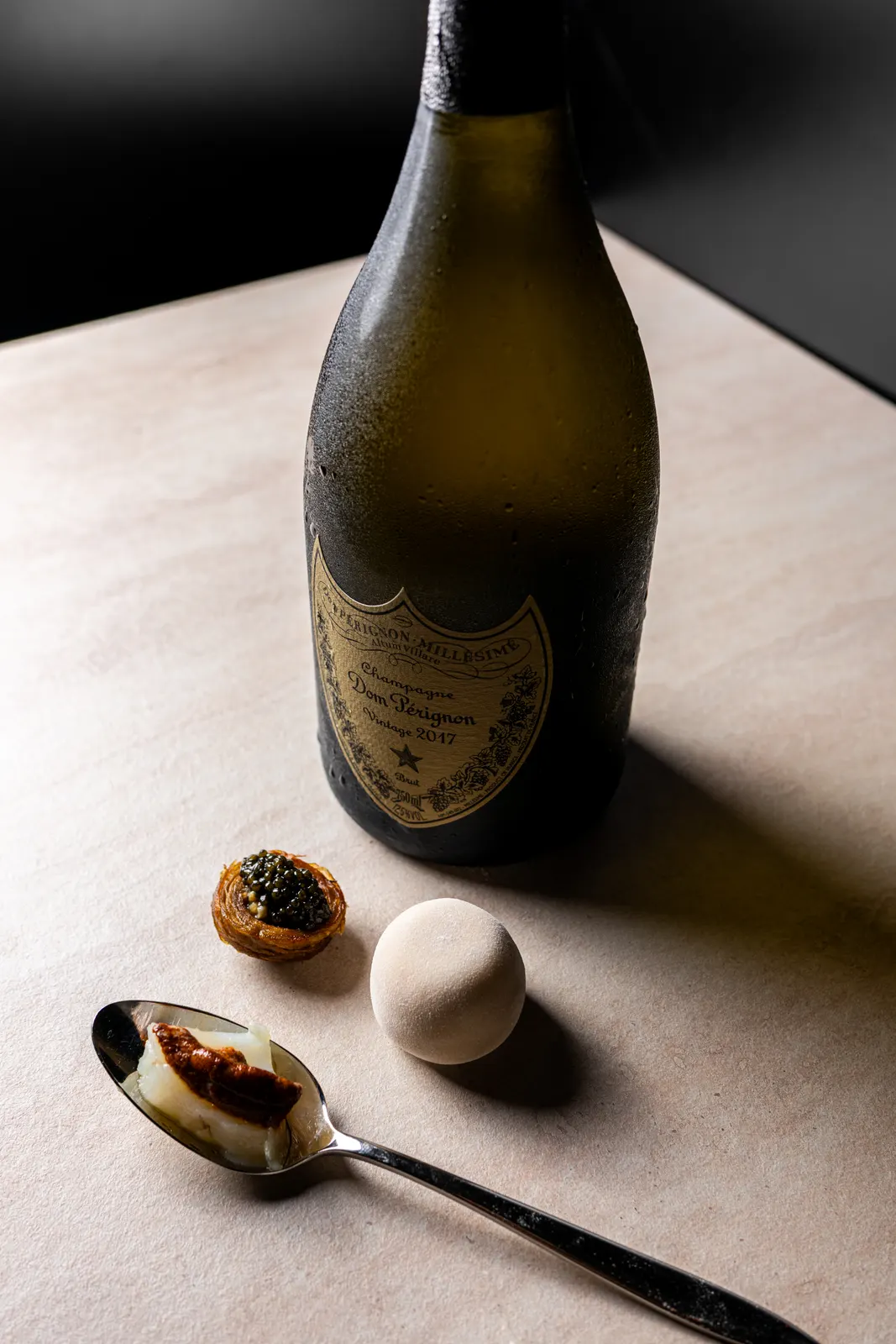
In Bilbao, for Dom Pérignon, the studio photographed each bite with the cuvée served alongside: a caviar tartlet, a white sphere and a spoon set on a pale surface, next to a bottle of Vintage 2017 beaded with condensation, in a raking light that leaves the background in darkness. It is the image at the top of this article: the dish leads the composition, the bottle signs it. In Paris, with chef Quique Dacosta, the plates were photographed on a gilded tabletop, facing a Dom Pérignon Vintage 2006 Plénitude 2: the gold of the table echoes the gold of the label. For the Dom Pérignon pairings at Le Meurice, the dish alone fills the frame: a tartlet, caviar on an oyster in a cloud of cold smoke. Each bite is plated for the lens, following the styling of a plate designed for the camera.
The reportage: what guests never see
A house dinner is prepared for hours in the kitchen, and those hours make the liveliest images. In Bilbao, the series moves from the Guggenheim Museum wrapped in fog to the kitchens of the museum's restaurant, where the chef plates a bite a few centimetres from a bottle. In Paris, the reportage of the dinner with Quique Dacosta moves from the kitchen to the dining room, ending with a portrait of the brigade. The method is that of discreet reportage in a Michelin-starred kitchen: capture the gesture, never interrupt the service. These moments can be filmed too. An event film extends the evening on social media, as we explain in our article on video that tells the story of a meal. All our series of gastronomic events follow this double view.
A dinner, a launch
Tell us about your event: we'll plan the table and the reportage together.
What can a champagne advertisement show in France?
In France, a champagne advertisement can show the product, its origin, how it is made and how it is enjoyed, provided it stays informative and carries a health warning. Images devoted to the terroir and know-how of an appellation wine even fall outside the scope of advertising. This is the Évin law, and it should be known from the brief, not at the moment of publication. Rules vary from one country to another; what follows describes French law.
Article L3323-4 of the French Public Health Code, in the version in force since 2016, limits alcohol advertising to information such as alcohol content, origin, name and composition of the product, and a few other items, including the production method and the way the product is consumed. It may refer to the terroirs of production, awards received and appellations of origin. Every advertisement must carry a health warning stating that alcohol abuse is dangerous to health.
Article L3323-3-1, created in January 2016, goes further for appellation wines such as champagne. Content, images, representations, descriptions, comments or references relating to a terroir, to know-how, or to the history or the cultural, gastronomic or landscape heritage linked to an alcoholic drink with a recognised quality or origin label are not considered advertising.
Self-regulation adds to the law. The ARPP alcohol code states that "the representation of persons must correspond with a real professional existing function" (sommelier, cellar master, chef) and that "it is forbidden to represent consumers". It also rules out any link between alcohol and luck, daring feats or sport.
| What the image shows | What the texts provide |
|---|---|
| The bottle, the label, the range | Allowed, if the packaging shown complies (L3323-4) |
| The cellar, the vineyard, the harvest | Outside the scope of advertising for an appellation wine (L3323-3-1) |
| The dish, the glass, the service | Allowed: way of drinking, food pairings (L3323-4, ARPP) |
| A sommelier, a cellar master, a chef | Allowed: professional role linked to the product (ARPP) |
| Guests drinking, a party among friends | To avoid in advertising: representation of consumers (ARPP) |
| Feats, luck, sport | Excluded (ARPP) |
This section describes the general framework in France. It replaces neither the advice of the house's or agency's lawyer, who approves each campaign before publication, nor the rules of the other countries where the images will appear.
Terroir, the image's safest ground
These texts align with the aesthetic stance of this article. The cellar, the vineyard, the gestures of the trade and the heritage of a house are both what sets it apart and what the law treats most freely. A campaign built on them wins twice, in distinctiveness and in safety. Conversely, the party among friends, so present in the imagery of champagne, is the most exposed in advertising.
The health warning belongs in the layout
The ARPP code sets the full French wording of the warning and its legibility. On a poster or a magazine page, it takes up a strip of the image: the photographer and the art director reserve that space at the shoot, rather than cropping afterwards.
Champagne, wine, spirits: what changes in the image
The method stays the same for a champagne, a wine or a spirit: the product, the place, the gesture. What changes is the material in the glass and the way light reveals it.
| Drink | What the image must show | The trap to avoid |
|---|---|---|
| Champagne | The bubbles, the mousse, the gold of the wine | A flute poured too early, the mousse gone |
| Red wine | The colour and its depth at the rim | A red so dense it looks black |
| White wine | Clarity and reflections | A white lost against a light background |
| Spirits | The amber colour, the thick glass, the ice | Stray reflections in cut glass |
The studio has photographed champagne houses, estates such as Château Simone, and bars and great tables from Paris to Tokyo. For a spirit, the lighting principles are those of champagne, with even stronger backlight: an amber colour only comes alive when light passes through it. It is at the heart of the studio's photography of bottles and tables.
Preparing a champagne house photo shoot
A house shoot is prepared around three decisions: the uses of the images, the locations and the season. Light, set and schedule follow from them.
- Uses. Website, merchant and e-commerce pages, press, social media, year-end campaign: each use has its format, portrait or landscape, cut-out or staged.
- Locations and season. The harvest lasts only a few weeks at the end of summer; the cellar can be photographed all year round; the studio, whenever suits. A festive campaign is shot several months before December.
- Bottles. New, unscratched bottles with perfectly applied labels, several per cuvée, following the list to prepare before a brand shoot.
- People. Who appears (cellar master, sommelier, chef, team), with what written consent and for which uses.
- Legal framework. The position of the health warning in the layout and the lawyer's approval, planned before the shoot.
A single art direction for every image
A house does not communicate with one image, but with hundreds, over several years. The bottle in the studio, the cellar, the vineyard and the dinner must speak the same language: the same light, the same palette, the same distance from the subject. That is the role of art direction for a house campaign, then of producing a shoot across several locations, from the studio to the cellar. The studio brings the same eye to palaces and their materials and to all the lifestyle houses and brands it works with, in line with Jordan Sapally's path alongside the great tables.
Frequently asked questions
- How do you photograph a bottle of champagne?
- Never with light from the front. Dark glass absorbs light and mirrors every source, so the bottle's silhouette is drawn with strips of light placed along its edges, against a background that sets it apart, and the reflections are steered away from the label. New, unscratched bottles, several per cuvée, then save hours of retouching.
- How do you photograph champagne bubbles?
- Backlit, at the moment of pouring. Bubbles only show when light passes through the wine, in a perfectly clean flute, against a dark background that brings out the gold. The mousse collapses within seconds, so the wine is poured once the camera is already set and framed, and the pour is repeated as many times as needed.
- What does French law say about champagne advertising images?
- In France, article L3323-4 of the Public Health Code limits alcohol advertising to objective information: origin, composition, production method, way of drinking, terroir, appellation, awards. Every advertisement carries a health warning about alcohol abuse. Since 2016, content about the terroir, know-how or heritage of an appellation wine is not considered advertising. Rules vary from country to country, and each campaign is checked by a lawyer.
- Can a champagne photo show people drinking?
- Not in an advertisement in France, according to the alcohol code of the ARPP, the French advertising self-regulatory body: people shown must hold a real professional role linked to the product (sommelier, cellar master, chef), and consumers may not be represented. A cellar master tasting, a sommelier pouring: the house is told through the people who make it. Event coverage is assessed case by case.
- When should you photograph a champagne house?
- It depends on the story. The harvest, at the end of summer, lasts only a few weeks; the cellar can be photographed all year round; the bottle and the range, in the studio, whenever suits. A year-end campaign is shot several months before December, to leave time for retouching, approvals and layout.
- What is the difference between a champagne photographer and a product photographer?
- A product photographer delivers the bottle, sharp and accurate, for a product page or a catalogue. A champagne photographer also delivers the story of the house: the cellar, the vineyard, the people, the table and the event, under a single art direction. A house needs both, and the packshot remains the foundation for everything else.
About the author
Jordan Sapally
Photographe culinaire et directeur artistique
Jordan Sapally dirige un studio créatif dédié à l'image culinaire et hôtelière de luxe. Formé par l'hospitalité et le voyage, il travaille pour des restaurants étoilés, des palaces et des marques food premium, en France et à l'international. Son parti pris : une image sensible, cohérente et durable, au service de la cuisine et du produit.