
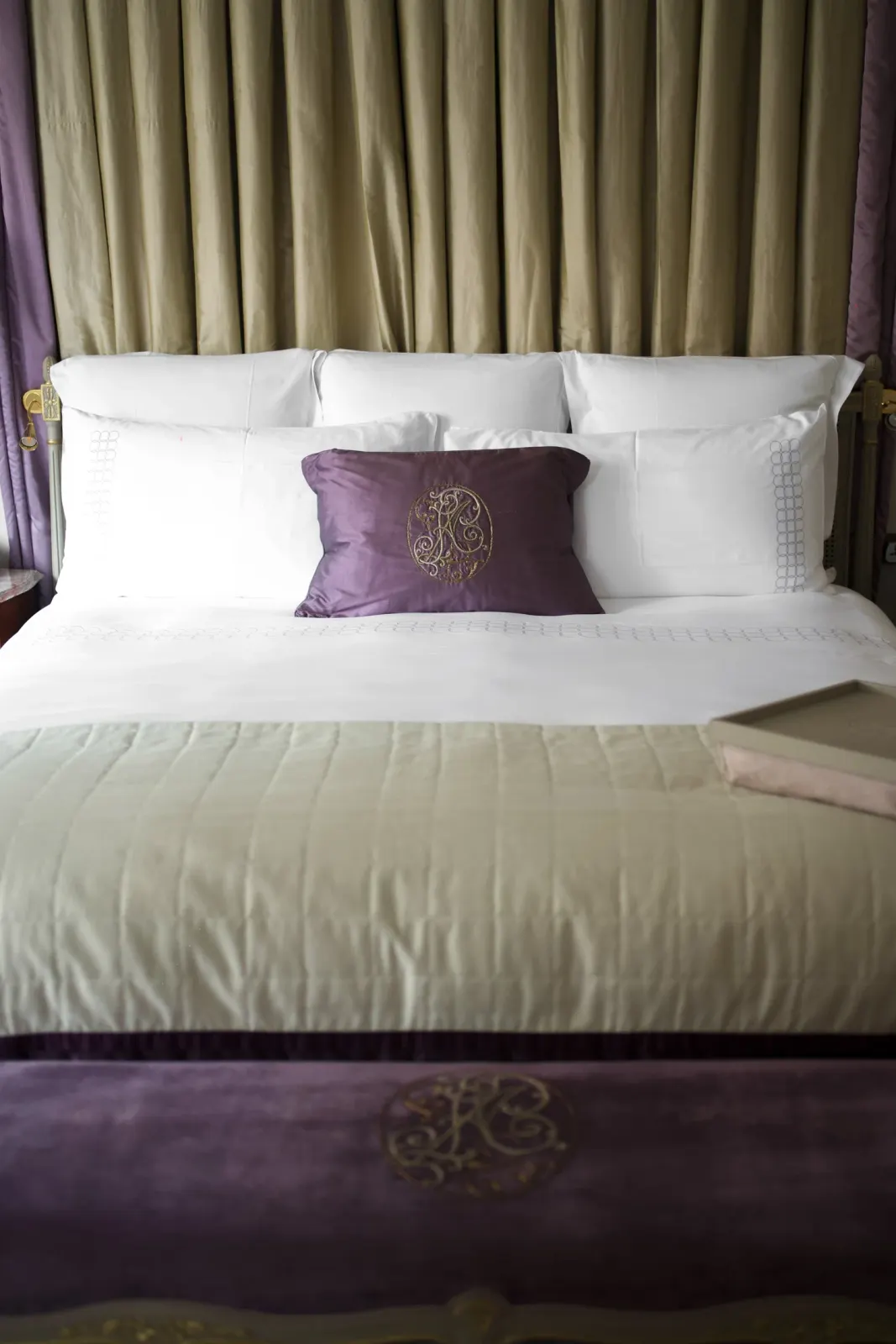
Photographing a hotel room means answering the questions a guest asks before booking: the size of the room, the bed, the bathroom, the light, the view. The method comes down to a few steps in a precise order: prepare the room like a set, wait for the right light, always take the same shots, and never make the room look bigger. This guide is for independent hotels and groups, from 2 to 5 stars, in France and beyond. It draws on the rooms photographed by the studio, from the San Regis in Paris to the Bastide de Moustiers in Provence.
In brief
Photographing a hotel room means showing what the guest buys without betraying it: a room prepared like a set, daylight, five shots per category (overall view, bed, bathroom, view, details) and a focal length close to the eye, never an ultra-wide lens that enlarges the room.
What should a hotel room photo show?
A hotel room photo should show exactly what the guest is buying: a bed, a volume, a light, a bathroom and, when there is one, a view. It is the room where they will spend the night, and it is often what tips the balance between two hotels of the same category.
The market is vast. According to INSEE, France's national statistics office (2025 data, published in July 2026), France has 618,200 hotel rooms, which recorded 220.2 million nights in 2025. Three-star hotels alone account for 247,900 of them. On booking platforms, all these rooms are presented the same way: a thumbnail, then a gallery the guest scrolls through in a few seconds.
Platforms set a minimum. Google Business Profile's official help asks for at least three photos of the rooms, and Booking.com recommends at least four photos per room type, plus one of the bathroom, as we explain in our article on hotel photo and video. These figures say how many images are needed, not which ones. That is what the method below is about.
A successful room series serves two readings at once. The guest looks for information (the size of the bed, shower or bath, what you see from the window); the hotel stakes its image on it. A photo that does only one of the two does half the job.
Preparing the room like a set
A room is prepared before it is photographed, like a film set: anything that does not help the guest picture themselves there leaves the frame, and everything that stays is adjusted to the millimetre. This preparation often takes longer than the shoot itself, and it is what separates a clean room from a room you want to book.
What leaves the frame
Cables and chargers, remote controls, documents piled on the desk, the bin, the "do not disturb" sign, labels and instructions: these objects serve the stay and go unnoticed in real life, but they jump out in a picture. The rule is simple. If the object says nothing about the room, it leaves for the time of the photo and goes back afterwards. The television stays, switched off, since it is part of the equipment the guest pays for.
What gets adjusted
The bed first, because it sits at the centre of most images: sheets pulled tight, the folds of the bedspread aligned, pillows plumped and placed identically. Then the curtains, set to let the light in, lampshades straightened, and bulbs of the same colour in every lamp. At the San Regis in Paris, these preparation gestures became images in their own right: a hand smoothing a mustard bedspread, a pillow being plumped against a headboard backed by floral wallpaper.
One reference room per category
It is neither useful nor possible to photograph every room in a hotel. For each category, you choose one representative reference room. Not the largest or the best exposed of its category: the photo would become a promise the other rooms cannot keep. Reception blocks it the day before, and the housekeeping team prepares it with the photographer. The same preparation list applies to every reference room, and it is what gives the series its consistency from one category to the next. It is written at the briefing stage, in the same way as what a brand lists before its shoot.
Which light should you use to photograph a hotel room?
Daylight first, lamps as an accent. A room is photographed when the window lights it fully, because that is the light the guest imagines when booking, and the one that best renders materials: the weave of linen, the patina of wood, the velvet of an armchair. The light in a room reads like the light on a plate, a point we develop in our article on natural and artificial light.
Daylight, depending on orientation
The time is chosen room by room. An east-facing room gets its best light in the morning, a west-facing room in the afternoon, and a north-facing room keeps a soft, steady light all day. The scouting visit, the day before or that same morning, sets the running order.
This is Jordan Sapally's own approach. In an interview with the French magazine Flannie, he explains that he always works in natural light and very rarely brings a spotlight or any artificial light.
In a room, this standard has a direct consequence: you wait for the light rather than create it, and the day is organised around it.
Lamps on: the two-colour trap
Switching on the bedside lamps warms up a room, but it mixes two colours of light: daylight, cooler, and the bulbs, warm and orange. In the picture, the walls take on two tints and white linen turns yellow near the lamps. Speaking about restaurants in the same interview, Jordan Sapally says that what he struggles with most are shoots full of strong orange lights.
There are two solutions. Switch the lamps off in full daylight, or save them for an evening shot, when the window darkens and the lamp becomes the main source. At the San Regis, one of the strongest images in the series is a room seen through a half-open door, the wall light on above the bed, the room bathed in golden light.
The window and the view
The window creates an exposure problem: the room is dark, the outside very bright, and the camera cannot render both at once. You have to choose. Either you expose for the room, and the window becomes a white source, softened by a sheer curtain. Or you show the view, and photograph it for its own sake, from the window or the balcony. At the San Regis, the view has its own image: breakfast served on the balcony, facing the rooftops of Paris.
The five shots of a hotel room
For each room category, five images answer the guest's questions: an overall view, the bed, the bathroom, the view and a detail. Together they form a series repeated identically from one category to the next, so the guest compares what matters: size, layout, view, equipment.
| Shot | What it tells the guest | The trap to avoid |
|---|---|---|
| Overall view | The size and layout of the room | An ultra-wide lens that enlarges the room |
| The bed | Comfort, bedding, type of bed | A loose sheet, mismatched pillows |
| The bathroom | Shower or bath, cleanliness, toiletries | The photographer's reflection in the mirror |
| The view | What you see from the window or balcony | The view from another room category |
| The detail | Materials, care, standing | An object missing from the room booked |
The overall view, from the doorway
The overall view is taken from where the guest discovers the room: the door or a corner of the room, at eye level, the camera perfectly level so that verticals (walls, doors, windows) stay vertical. A leaning vertical makes the room seem to tilt. At the San Regis, the studio often framed the room from a doorway, a blurred armchair in the foreground: the room gains depth without being distorted.
The bed, the bathroom, the view
The bed is photographed at three-quarters, close enough to read the texture of the linen, far enough to understand its size. The bathroom, which Booking.com asks for explicitly, is framed without facing the mirror; at the San Regis, a single image is enough to convey the marble, the bath and the taps. The view, finally, appears only if it truly belongs to the category photographed. Showing a suite's view on the listing of a standard room is a promise the hotel cannot keep.
The details that define the category
Details say what wide shots cannot: quality. A bathrobe on a hanger bearing the hotel's name, toiletries lined up on marble, an antique desk, a brass door handle, a welcome tray. This eye for materials is the one the studio brings to the image of a palace hotel, and it applies just as much to a 3-star hotel: on the same platform, a room often stands out from its neighbour through a detail.
How do you avoid making a hotel room look bigger than it is?
By keeping a focal length close to human vision and finding distance through where you stand, not through the lens. An ultra-wide lens is the temptation of every small room: it pushes back the walls, stretches the foreground and distorts furniture at the edges of the frame. The guest then discovers a smaller room than in the photo, and the disappointment starts at the door.
The minimum sizes set by the French hotel classification guide published by Atout France show how strong the temptation is. In France, a double room, bathroom included, must measure at least:
| Category | Minimum size of a double room |
|---|---|
| 2 stars | 10.75 m² |
| 3 stars | 13.5 m² |
| 4 stars | 16 m² |
| 5 stars | 24 m² |
The grid also allows a 10% tolerance on these sizes for up to 20% of rooms. In 13.5 m², a very wide lens can suggest twice the space.
Accuracy is also a rule. Google asks for images that reflect reality and are not heavily edited. In France, Article L121-2 of the Consumer Code treats as misleading any commercial practice based on false or misleading presentations, in particular about the essential characteristics of a service. Rules vary from one country to another, but the principle is the same: a room photo presents the service being sold, so it should present it as it is.
The studio applies this principle to the letter. In its series at the Bastide de Moustiers, in Provence, 73 of the 74 images were shot at 40 or 50 mm, focal lengths close to the eye. The only wide-angle photo is the breakfast table seen from above, on the terrace. Jordan Sapally takes the same pared-down approach in restaurants, which he says he likes to enter with his camera body and a single 35 mm lens.
Rooms shown as they are
Tell us about your room categories, and we'll prepare the series together.
Empty room or lived-in room?
Both, for two different uses. The empty room, prepared and without anyone in it, is the reference image: it goes on the website, Booking.com and the Google listing, because it shows the room exactly as the guest will find it. The lived-in room tells the story of a stay: it serves the brand image, social media and campaigns.
At the Burgundy in Paris, the studio photographed both. On one side, the bed, its headboard and the light from the window. On the other, a breakfast tray resting on the duvet, a cup of coffee held above rumpled sheets, a figure in a bathrobe at the window, glass in hand. These images do not say how big the room is; they say what you live there. The human presence remains suggested: a hand, a silhouette, a back, rarely a face.
These images feed social media in the same way as the photos a restaurant posts on Instagram. The people who appear, guests, staff or extras, give their written consent. The studio's production team handles casting, props and scheduling, and the same shots can be filmed on the same day for short formats, as part of Jordan Sapally's films and video work.
Organising the shoot day, room by room
A shoot day is built around two constraints: the orientation of the rooms and their availability. The scouting visit combines the two and sets a running order that reception knows in advance.
The running order
East-facing reference rooms are shot in the morning, west-facing ones in the afternoon, rooms on the courtyard or facing north whenever the schedule allows. Reception frees them the day before, housekeeping prepares them in the same order, and shared spaces (lobby, bar, breakfast room) fit into the gaps in the day.
One group, one grid
For a hotel group, the five-shot series becomes a charter: same framing, same camera height, same time of light, same colour rendering in every property. A guest moving from one address to another then compares rooms, not photographers' styles. This grid belongs to art direction: it is set once, then applied to each hotel.
Retouching and delivery
Retouching corrects, it does not transform: faithful colours for fabrics and wood, straightened verticals, a mark removed from a wall. When a breakfast or room-service tray enters the frame, it follows the rules of food styling: fresh produce, shown as it will be served. Files are delivered in high definition for the website and platforms, and cropped for the Google listing and social media.
Before photography, Jordan Sapally studied tourism and worked in Parisian palace hotels, a path told on his About page. That is where his attention to the room comes from, the place where a hotel keeps its promise. His room series, from the San Regis to the Burgundy, are gathered in the studio's hospitality projects, and Jordan Sapally's hotel and food photography carries the same approach from the room to the table.
Frequently asked questions
- How do you photograph a hotel room?
- In four steps. Prepare the room like a set: bed pulled tight, everyday objects removed, curtains adjusted. Wait for the hour when daylight enters the room fully. Take the five useful shots (overall view, bed, bathroom, view, detail). Then check that the series shows the room exactly as the guest will find it, without making it look bigger.
- How many photos do you need per hotel room?
- Plan at least five images per room category: an overall view, the bed, the bathroom, the view and a detail. Booking.com recommends at least four photos per room type plus one of the bathroom, and Google at least three photos of the rooms. A hotel with three room categories therefore needs around fifteen room images.
- Which lens should you use to photograph a hotel room?
- A focal length close to human vision rather than an ultra-wide lens. An ultra-wide lens makes the room look larger than it is and distorts furniture at the edges of the frame. In the studio's series at the Bastide de Moustiers, 73 of the 74 images were shot at 40 or 50 mm. Distance comes from where the photographer stands, not from the lens.
- What time of day should you photograph a hotel room?
- When daylight enters the room fully, which depends on its orientation: the morning for an east-facing room, the afternoon for a west-facing one. A north-facing room keeps a soft light all day. The scouting visit sets the running order, and an evening shot with the bedside light on can complete the series.
- Can hotel room photos be retouched?
- Yes, to correct colours, straighten verticals or remove a mark on a wall, but not to change the room. Google asks for images that reflect reality and are not heavily edited. In France, the Consumer Code also penalises presentations likely to mislead customers about the essential characteristics of a service they are buying.
- Should hotel room photos include people?
- Not the reference photos, which show the room exactly as the guest will book it. A suggested presence (a hand smoothing a bedspread, a breakfast tray resting on the duvet) does serve the brand image and social media. Both series can be shot on the same day, with the written consent of anyone who appears in the pictures.
About the author
Jordan Sapally
Photographe culinaire et directeur artistique
Jordan Sapally dirige un studio créatif dédié à l'image culinaire et hôtelière de luxe. Formé par l'hospitalité et le voyage, il travaille pour des restaurants étoilés, des palaces et des marques food premium, en France et à l'international. Son parti pris : une image sensible, cohérente et durable, au service de la cuisine et du produit.