
A restaurant does not need to post every day on social media. It needs the right images, in sufficient number, showing what the guest is about to experience: the plate, the dining room, the faces of the house. This content is prepared and produced in one block, then released over the following weeks on the Google profile, Instagram and the website.
In brief
A restaurant should post four families of images: its dishes, its venue, its team and the life of the house. Google advises at least three photos of the dishes, the dining room, the façade and the team. The most effective approach: produce everything in one day, then post over the following weeks.
What a restaurant should show: four families of images
A restaurant's social media rests on four families of images: the dishes, the venue, the team and the life of the house. It is also the grid Google offers to businesses. Its help page on Business Profile photos advises adding at least three photos of food and drink, three of the interior, three of the exterior and three of the team. This minimum holds for every channel, because a guest discovering an address on Instagram looks for the same answers as on Google Maps: what is served, what the dining room looks like, who will greet them.
Dishes, plated as they are served
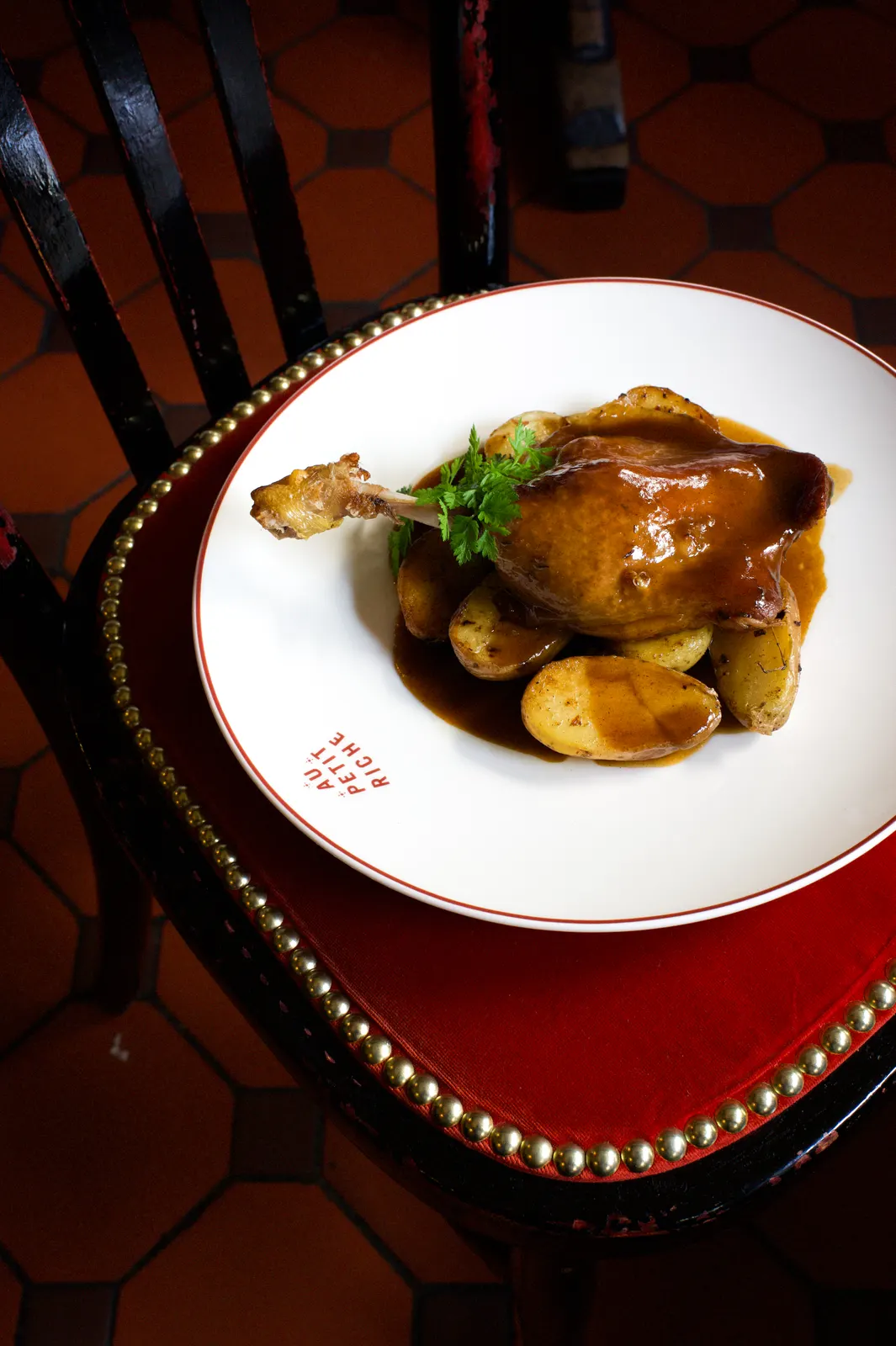
The dish is the image people expect first from a restaurant. The signatures, one or two starters, a standout dessert and the drinks form a solid base. Google specifies that the image should stay true to reality, without significant retouching or excessive use of filters or AI: a dish embellished on screen disappoints at the table. At Au Petit Riche, in Paris, a dish from the menu is served on a plate bearing the name of the house, set on a red velvet chair. The dish and the identity of the place fit within the same image. This work of adjusting without betraying is food styling, and light does the rest, as we explain in our article on light in food photography.
The venue, before service
The dining room is photographed empty, clean, in its best light, usually in the morning. Google advises shooting the exterior from several angles and at different times of day, so that guests recognise the façade as they arrive. Details matter as much as wide views: a banquette, a mosaic floor, a row of laid tables. At Au Petit Riche, the dining room seen from the entrance and the tiles of the floor speak to the age and character of the house better than a long text.
The team and the gesture
A restaurant is also a set of faces. At Brasserie Lutetia, the chef sauces a plate, alone in the darkened dining room. At Au Petit Riche, the chef and the director stand side by side in the dining room. At Simple Café, in New York, the owner welcomes guests at the entrance with a smile. These portraits give the house a face before the booking is even made, and Google advises at least three of them on the profile.
The life of the house
The fourth family gathers what keeps an account alive between two new menus: behind the scenes (a tray of potatoes in the oven, in the kitchen), details (a row of colourful flutes casting long shadows across a table, at Simple Café) and the dining room in full swing, with guests at their tables. These images call for particular care as soon as a face is recognisable, as we will see below.
The Google profile first, because others post there for you
The Google Business Profile is the channel where your guests post photos in your place. Google's help page on popular dishes makes it clear: the restaurant and its guests can both add photos and dish names, and the names added by the business take priority over those added by guests. Without photos of your own, your dishes are therefore represented by images taken on a phone, at the end of a meal, under the dining room lighting.
Posting your own images sets the reference. Google's technical guidelines are straightforward: photos in JPG or PNG format, between 10 KB and 5 MB, ideally 720 x 720 pixels, and videos of 30 seconds at most in at least 720p. An update with every new menu is enough to keep the profile true to what the guest will find at the table. Our article on what a professional photographer brings details the gap between these two kinds of images.
Taking stock
Let's look together at your Google profile, your account and what is missing.
Instagram, Google, website: one format per channel
Each channel expects a different format, and the same shoot has to serve them all. The stakes are broad: according to France's Baromètre du numérique 2026 (Crédoc for Arcep, Arcom, the CGE and ANCT, survey conducted in June 2025), 90% of internet users in France use social networks and video-sharing platforms. One user in three posts or comments every day, and the figure rises to 52% among under-25s.
| Channel | What it expects | What to post there |
|---|---|---|
| Google profile | JPG or PNG photos, 720 x 720 px recommended; videos of 30 seconds at most | Dishes, dining room, façade, team, updated with each menu |
| Instagram, feed | Vertical images, a coherent series | Signature dishes, venue, portraits |
| Instagram, Reels and Stories | Full-screen vertical video | Gestures, behind the scenes, service, announcements |
| Website and booking | Horizontal, high-definition images | Dishes, dining room, atmosphere |
The consequence plays out on the day of the shoot: an image tightly framed in landscape crops badly into portrait. It is better to plan both framings for the key images, with some air around the subject. Instagram's exact dimensions are detailed in our article on packshots and in-context product photography.
Photo or video: photography first, video for the gesture
Photography remains the foundation, and short video tells what a photo cannot show. The Google profile, the menu, the website and the press live on photographs. Vertical video shows the chef's gesture, the flame under the pan, the service picking up pace, the sound of the dining room. Our article on food film details how a dish becomes a story, and the studio's film and video work covers both short formats and more structured films.
Instagram itself sets out the rules of the game. On its official blog for creators (January 2025), the platform writes that one of the most effective ways to grow is to regularly post original content. For a restaurant, original means shot on your premises, with your dishes and your team.
Photo and video are ideally produced on the same day: the dishes, the light and the team are already there. It is the same logic we apply to hotels, detailed in our article on photo and video for a hotel.
Produce in one day, post for weeks
A restaurant's content is produced in one block and posted as you go. A well-prepared day of shooting feeds the Google profile, the website and several weeks of posts. Producing day by day, between two services, gives uneven images and an account that runs out of breath.
Plan by families of images, not by posting day
The shot list is built from the four families, not from a posting calendar. Start with the dining room and the façade while the light is at its best, move on to the dishes by family, then to the portraits and the videos of gestures. Each key image is framed for several formats, and the art direction of the series (light, palette, tone) is set before the day so that every image speaks to the others. The detail of this organisation is in our method for preparing a restaurant shoot.
Align the content with the life of the restaurant
The right moments to produce are those when the image carries something at stake: a new menu, a change of season, the end-of-year festivities, an event, a new hire in the kitchen. One shoot per menu or per season is enough to keep an account alive without starting from scratch every week. To formalise what you expect from each session, our briefing checklist transposes easily to a restaurant.
Planning your shoot
A well-prepared day feeds your social media, your website and your Google profile.
Guests and team in the picture: consent before posting
Before posting a recognisable face, whether a guest or a member of the team, ask for the person's consent. In France, image rights derive from article 9 of the Civil Code, which states that everyone has the right to respect for their private life; rules vary from one country to another. A photo of a lively dining room or a portrait of a waiter is no exception because it appears on a restaurant's account.
In practice, three reflexes are enough. For the team, obtain written consent specifying the channels (social media, website, Google profile) and the duration. For guests in the foreground, ask before pressing the shutter. For guests in the background, a tight frame, a shallow depth of field or a blur avoids the question. The simplest approach is to build it into the organisation of the shoot, in the same way as the time slot or the list of dishes.
What you can do yourself, and what is worth entrusting
Day-to-day content is posted from a phone, and reference images are entrusted to a professional. A story about the morning delivery, the dish of the day on the blackboard or a behind-the-scenes moment caught on the fly are better left spontaneous. The images that represent the house for months, on Google as on the website, call for light, framing and direction.
| On the phone, by the team | With a photographer |
|---|---|
| Daily stories, deliveries, dish of the day | Signature dishes and the menu |
| Behind the scenes caught on the fly | Dining room, façade and the light of the venue |
| Announcements and practical information | Portraits of the team |
| Sharing guests' posts | Short videos, shot and edited |
The studio supports restaurants, bistros and brasseries with these reference images, and its production work carries them through the following months. The series created for houses such as Au Petit Riche or Brasserie Lutetia can be seen in our food work. To understand how the studio organises these projects, our article from food photographer to creative studio tells the story of that transition.
Frequently asked questions
- Which photos should a restaurant post on social media?
- Four families of images cover the essentials: dishes plated as they are served, the venue (dining room and façade), the team, and the life of the house (behind the scenes, details, service). Google itself advises at least three photos of food and drink, of the interior, of the exterior and of the team on the Business Profile. The same series then serves Instagram and the restaurant's website.
- How many photos should a restaurant put on its Google Business Profile?
- Google's help pages advise at least three photos in each category: food and drink, interior, exterior and team, which means a dozen images at the very least. Photos should be JPG or PNG, ideally 720 x 720 pixels, without significant retouching or excessive use of filters or AI. Update them with every new menu.
- Should a restaurant post photos or videos?
- Both, with different roles. Photography remains the foundation: the Google profile, the menu, the website and the press. Short vertical video shows what a photo cannot, such as the chef's gesture or the atmosphere of the service. On a Google Business Profile, a video lasts 30 seconds at most. Shooting both on the same day avoids paying for the logistics twice.
- How often should a restaurant post on Instagram?
- Consistency matters more than volume. Instagram states that regularly posting original content is one of the most effective ways to grow. For a restaurant, a pace you can hold all year is worth more than one intense week followed by a month of silence. The simplest approach is to produce the images in one block, then schedule their publication.
- Can you post photos of your guests or your staff?
- Only with their consent. In France, image rights derive from article 9 of the Civil Code on respect for private life, and rules vary from one country to another. Before posting a recognisable face, ask for the person's agreement, ideally in writing, specifying the channels concerned: social media, website, Google profile. For guests in the background, a tight frame or a blur avoids the question.
- Can all of a restaurant's content be produced in a single day?
- Yes, if the day is prepared. Start with the dining room and the façade while the light is at its best, move on to the dishes by family, then to portraits and videos of gestures. Such a day feeds the Google profile, the website and several weeks of posts. It is renewed with each new menu or each season.
About the author
Jordan Sapally
Photographe culinaire et directeur artistique
Jordan Sapally dirige un studio créatif dédié à l'image culinaire et hôtelière de luxe. Formé par l'hospitalité et le voyage, il travaille pour des restaurants étoilés, des palaces et des marques food premium, en France et à l'international. Son parti pris : une image sensible, cohérente et durable, au service de la cuisine et du produit.